
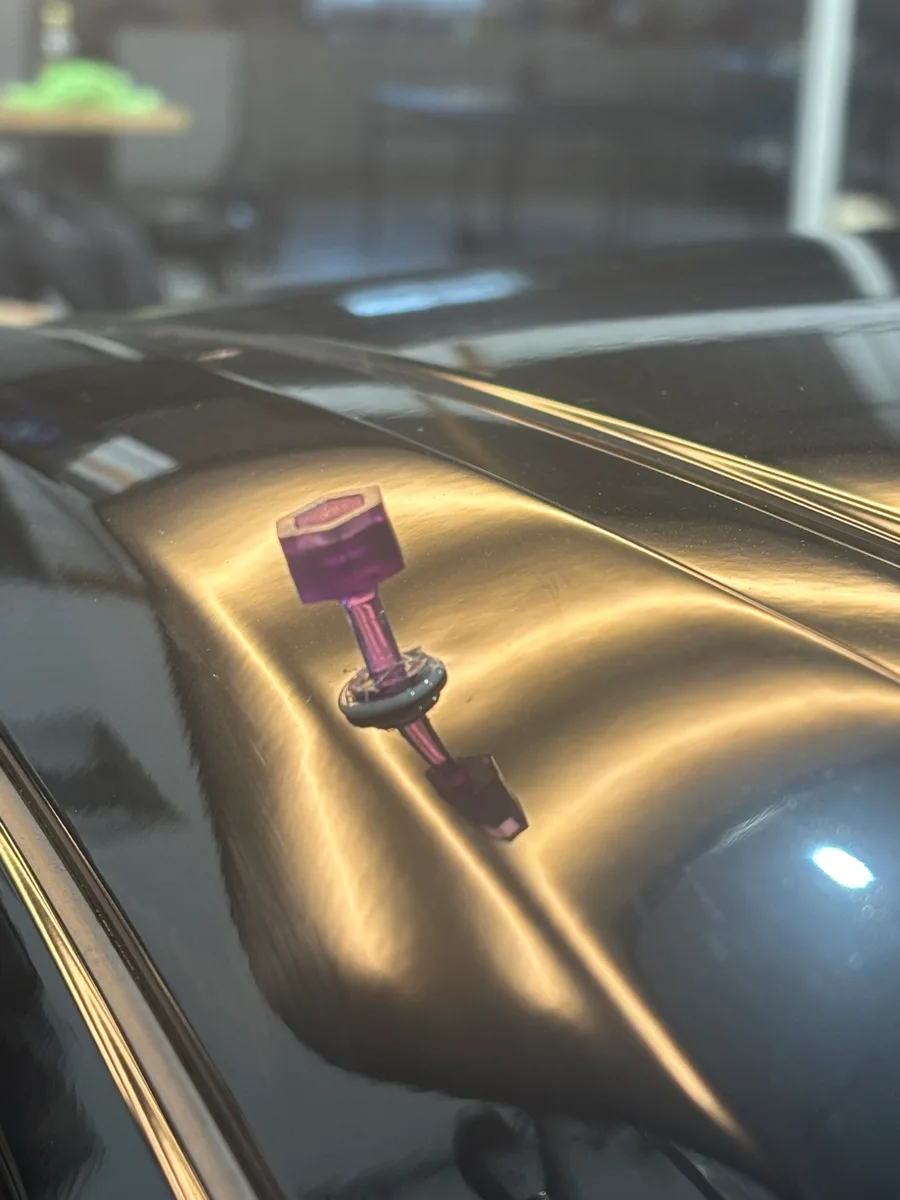
When hail happens, you've got two real choices: a paintless dent repair specialist (PDR), or a conventional body shop. Most first-time hail customers don't realize these are different things — they just go wherever their insurance company steers them. That default choice costs thousands of dollars at trade-in time. Here's why.
The two methods, in two sentences
PDR is a metal-finishing process: technicians work behind the panel with precision rods or pull tabs on the front to massage dents back to factory contour. Nothing gets removed, replaced, sanded, or painted — your factory paint stays untouched.
Body shop repair is a replacement process: technicians either replace the entire panel or they grind out the dents, apply body filler, sand it smooth, prime, and repaint. The damaged metal is either gone or buried under filler and new paint.
Why PDR is the right tool for hail specifically
Hail damage is almost always cosmetic, not structural. The hailstones denst the sheet metal but don't crack the paint (unless the ice was unusually large and sharp). The dents are shallow. The surface area is large. The number of individual dents is high.
This is exactly the damage profile PDR is built for. A skilled technician can repair 100 dents on a single panel in the time it would take a body shop to grind out filler on a single one. And because the paint is intact, there's nothing to match, nothing to blend, and no risk of the repaired area fading at a different rate than the rest of the vehicle.
What you lose at the body shop that you keep with PDR
Factory paint value
Your factory paint is a real asset. OEM paint is applied under controlled conditions — specific temperature, specific humidity, specific spray equipment — that a body shop can approximate but never exactly replicate. Repainted panels typically fade at a slightly different rate than original panels, and the color match is within 2–3% rather than identical. Most of the time you won't see the difference. At trade-in, the dealer will.
CarFax resale value
Body shop work generates a CarFax body repair record. Dealers and private buyers see it, and they price accordingly. Even if the repair was performed flawlessly, a vehicle with a body repair on CarFax typically sells for 5–15% less than the same vehicle without the flag. On a $30,000 SUV, that's $1,500–$4,500. On a $60,000 luxury vehicle, $3,000–$9,000.
PDR does not generate a CarFax body shop record. No filler, no repaint, no flag.
Time
PDR repairs typically take 1–3 shop days for moderate hail damage. Body shop work for the same damage runs 2–4 weeks because of the strip-fill-sand-prime-paint-cure cycle. Four weeks in a rental is four weeks of your time, four weeks of planning around a loaner, and potentially out-of-pocket rental costs if your policy has a daily cap.
When a body shop actually is the right answer
PDR isn't magic. It has limits. The damage scenarios where a body shop becomes the right call:
- Cracked or chipped paint. If hail impact cracked the clearcoat or paint, PDR can't restore it — the damage is no longer just in the metal.
- Dents on sharp body lines or folded edges. Some body lines can be repaired by a skilled PDR tech, but the tightest creases and folded edges require panel replacement.
- Previously repaired panels with filler. If a previous repair added body filler to a panel, PDR can't push against it — the filler absorbs the force.
- Repair cost approaching panel replacement cost. For severe hail on a single panel, replacement sometimes comes out cheaper than PDR.
A professional PDR shop tells you honestly when a body shop is the right answer. We'd rather refer you out than take on a repair we can't finish well.
"My insurance steered me to their body shop"
Insurance companies have Direct Repair Programs — shops they've negotiated rates with. They'll suggest you use one. You are not required to. Missouri and Kansas both have anti-steering laws. Ask your adjuster: "I'd like to use a PDR specialist. Will you work with them directly?" The answer is yes — they have to.
How to actually tell a PDR shop from a body shop
The shop's own website tells you everything you need to know. A PDR specialist will talk about line-board inspection, panel-by-panel dent mapping, glue pull, and CCC ONE formatting. A body shop will talk about collision repair, paint matching, and frame straightening.
You can also just ask: "Do you use body filler for hail damage repairs?" A PDR shop will say never. A body shop will say "for severe damage, yes." That answer tells you what the repair is going to look like.
For Kansas City drivers specifically
KC metro sees significant hail events roughly 3 out of every 4 years. If you're planning to keep your vehicle long term, this matters less — the repair either way will hold. If you're planning to trade or sell in the next 3–5 years, PDR vs body shop is a resale-value decision worth thousands of dollars.
We exclusively do PDR for hail. It's the service we built the shop around. The full comparison lives on our PDR vs Body Shop page, and when you're ready, start your claim online and we'll handle the rest.